Cubeler and personal projects · 2026 · Process
Evaluating AI Agent Work
The eval process I use to make sure that what a coding agent reports as done is done, and is correct.
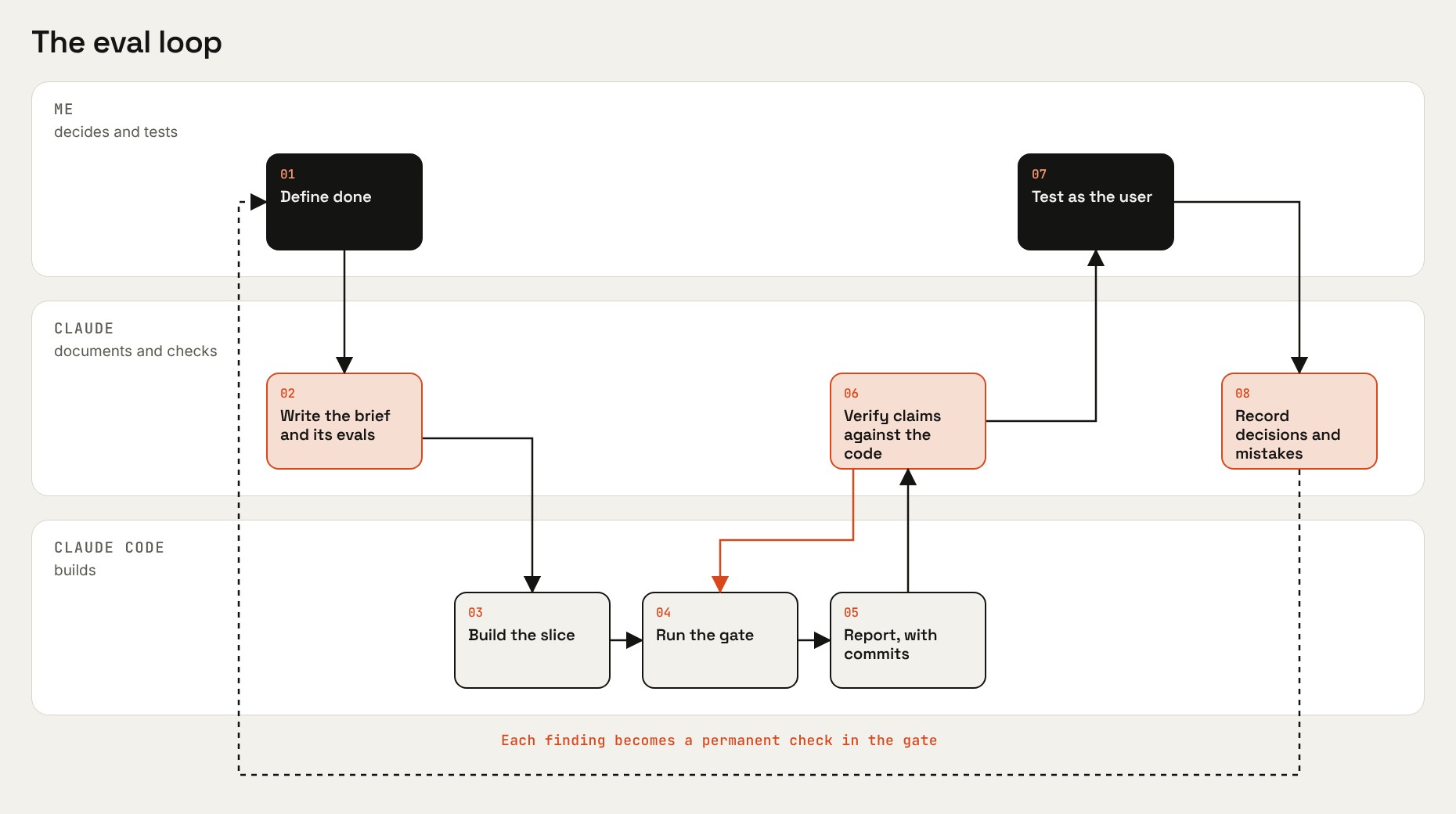
An eval (evaluation) is a check that proves a piece of agent work is done and is correct. Coding agents work fast and their reports read well, even when the work is incomplete. This case study describes the process I use to evaluate agent work on Accounting Plus and on my personal projects. It also lists where I think the process can be improved.
Introduction
When I started directing AI coding agents on Accounting Plus, I noticed that the status reports were always positive. The feature was built, the tests passed and the gate was green.
I am a designer and not a software engineer, so I could not rely on reading every line of code myself. I needed a process where the work is proven and not just reported.
I use three actors. I decide what is done, Claude documents and checks, and Claude Code builds. The eval process is what connects the three.
In this case study each statement is followed by a white box. The box contains the proof, taken from the project record.
The Problem
Early on I identified 4 ways that agent work can look finished when it is not.
A status report can claim something that the code does not do.
A green gate only proves what the gate checks.
When the spec has a gap, the agent fills it with a plausible guess.
A check that nobody runs is the same as no check.
Accounting Plus generates tax deadlines for accounting firms, and a wrong deadline is real-world harm. Thus “it looks done” was not an acceptable standard.
Process
The diagram at the top of this page shows the loop that every piece of work goes through. Here are the 8 steps.
1. Define done. Before any code is written, I decide what the work must do and what is out of scope.
2. Write the brief and its evals. Claude writes a work brief with the goal, the decisions already made, the build order, and the evaluation that proves each step is done.
3. Build the slice. Claude Code builds one increment against the brief. The brief states what the agent can decide alone, what it must escalate, and what it must never do.
4. Run the gate. Every increment has to pass the automated checks before it is reported.
5. Report, with commits. The agent ends each session with a status report. It lists the commit hashes, what shipped, and the assumptions it made where the spec did not provide direction.
6. Verify the claims against the code. Claude checks every claim in the report in a snapshot of the code, and ranks its findings by severity.
7. Test as the user. I test every build myself. I put myself in the mind of the user, test the flows, inject error conditions and look for empty states.
8. Record decisions and mistakes. Decisions and open questions go into a dated register with IDs, so a report, a review and a PRD can refer to the same thing.
I also check the hand-off itself.
Types of Evals
No single check is enough, so I use several. Each one proves something different. The last column is the proof.
| Eval | What it proves | Who runs it | Proof |
|---|---|---|---|
| Acceptance criteria | The work does what the spec says | Claude and me | The 9 acceptance tests in the sector pack brief |
| Automated gate | Typecheck, lint, tests and build all pass, so nothing that worked before is broken | Claude Code, and CI on every push | A parity check that the TypeScript and Python rule engines produce the same dates |
| Contract checks | The frontend and the backend agree on every endpoint | CI | A guard that fails if the frontend calls an endpoint that is not declared in the contract |
| Claim verification | The status report matches the code | Claude | A reported test that did not exist in the code |
| Risk-first code review | The code where a mistake would do the most harm is correct | Claude | 6 review tranches, starting with client sign-in and the rules engine |
| Gap analysis | The spec itself is not missing something | Claude, reviewed by me | 22 findings. One was that a dropped accounting link would hide the deadlines from the accountant |
| Hands-on testing | The product works for a real user | Me | Signing in DocuSign and finding the document in Google Drive |
| Expert sign-off | The tax rules and dates are correct | Tax subject matter experts | Researched rules are stored with the status “UNVERIFIED” until an expert signs them |
No eval run by an agent replaces the sign-off of a tax expert. The software never invents tax content.
Claim Verification
A report is a claim and the code is the evidence. Checking the agent's report against the code has been the most useful eval.
The reviewer is held to the same rule.
Risk-First Review
I ask how much has actually been checked.
The review is ordered by where a mistake would do the most harm. Reviewing everything at the same depth was not realistic, so the backend review was organized into 6 tranches:
- Client sign-in
- The rules engine and its date math
- Data isolation between firms
- Document storage
- E-signature
- Firm-side routes and permissions
One review is fixed and verified before the next one starts.
The best reviews end by making themselves unnecessary. A finding is turned into a permanent automated check, so the same mistake cannot return.
What Went Wrong
The process was built from mistakes. Here are 4 rules, each with the mistake that produced it. All are recorded in the project's working agreement.
Run the test suites of the neighbouring repositories when a change touches them.
A check runs before the work it protects, and stops everything on failure.
List what exists from where it is defined, or render the screen. A search for names that were guessed in advance can only confirm the guess.
I start the local development services myself.
Personal Projects
On my personal projects there is no spec bundle, but the same evals apply at a smaller scale.
Visual Synth. Each build was rendered in a headless browser and its pixels were checked before I saw it. I then tested it on the real rig with the MC-707, the projector and the webcam.
Scene Arranger. A fixed set of browser tests runs after each change to catch regressions. I ask for the root cause to be found before any patch.
Fluxions. I ask for a blunt assessment of the result, not only of the code.
Kestrel simulator. Here the roles are reversed. I write the code and Claude reviews it.
Where I Could Improve
Write the evals first, every time. On Accounting Plus the brief states how each step is proven. On my personal projects I asked for features one sentence at a time, with no acceptance criteria.
Turn my hands-on testing into repeatable tests. My testing as the user finds real problems, but it is manual and it is not recorded. The flows, error conditions and empty states I check should be written as test cases and automated.
Add a second opinion. The same family of AI models writes the spec, builds the code and reviews it, so they may share the same blind spots. The highest risk code should also be reviewed by a software engineer or by a different model.
State the performance budget up front.
Measure the process. I do not track findings per review, defects that escaped to my own testing, or the time from a report to its verification. Without those numbers I cannot show that the process is improving.
Rely less on the reviewer's explanation. I ask the agent to clarify when an explanation is dense, but I still depend on it.
Eval Prompt
This page is also a working reference for me. Here is a prompt that runs the eval. It is given to the reviewing agent together with the coding agent's status report, the latest code and the work brief.
The text in square brackets is replaced for each run.
You are the reviewer in a three-party build. I am the owner and I decide what is done. A coding agent built the work. Your job is to evaluate it. You do not fix code and you do not make product decisions.

INPUTS
- Status report from the coding agent: [paste or attach]
- Code snapshot or repository at commit: [commit hash]
- Work brief and acceptance criteria for this work: [paste or attach]
- Open findings from the last review: [paste, or "none"]

RULES
1. The report is a claim. The code is the evidence. Check every claim in the code, not in the report.
2. Never rely on memory of what a document or file says. Open it and read it.
3. To prove something is absent, search the whole codebase and show the search you ran. Do not search only for names you guessed. List what exists from where it is defined.
4. Never invent content that has a correct answer in the real world, such as a date, a rule, a code or a number. If it is missing, say it is missing.
5. If you cannot verify a claim, say so. Do not mark it as verified.
6. A decision that belongs to the owner comes back as a short question with your recommendation. Do not decide it yourself.

STEPS
1. List every claim in the status report, one per line.
2. For each claim, find the evidence in the code. Give the file and line. Mark it VERIFIED, PARTLY, NOT FOUND or COULD NOT CHECK.
3. For each acceptance criterion in the brief, say whether it is met and name the test or code that proves it. Flag any criterion that has no test.
4. Run the automated gate if you can (typecheck, lint, tests, build, contract checks). Report the real output. If you cannot run it, say so.
5. Re-check each open finding from the last review. Confirm the fix in the code and confirm that its test exists.
6. Review the changed code, starting where a mistake would do the most harm. State the order you chose and why.
7. Check that the report does not claim a decision the owner has not made.

REPLY IN THIS FORMAT
A. Verdict: one line. ACCEPTED, ACCEPTED WITH FINDINGS, or NOT ACCEPTED.
B. Claims table: claim, status, evidence (file and line).
C. Acceptance criteria table: criterion, met or not, proof.
D. Findings, ranked HIGH, MEDIUM, LOW. For each one: what is wrong, the file and line, the harm it could cause, and the fix you recommend.
E. For each finding, a permanent check (a test or lint rule) that would stop it from coming back.
F. Coverage: what you read line by line, what you checked by search, and what you did not review. Use real numbers.
G. Questions for the owner, each with your recommendation.
H. What the owner should test by hand: the user flows, the error conditions and the empty states that this work touches.
I. An entry for the decision register: date, what was verified, what stays open.
The prompt covers steps 6 and 8 of the loop. Step 7, testing as the user, stays with me. The last section of the reply gives me the list of what to test by hand.
Conclusion
My main takeaway is that an agent's report is a claim and not evidence. The evidence is in the code, in the tests and in my own hands on the product.
In addition every mistake should end as a permanent check. A rule that is only written down will be forgotten, but a check that runs on every build will not.